


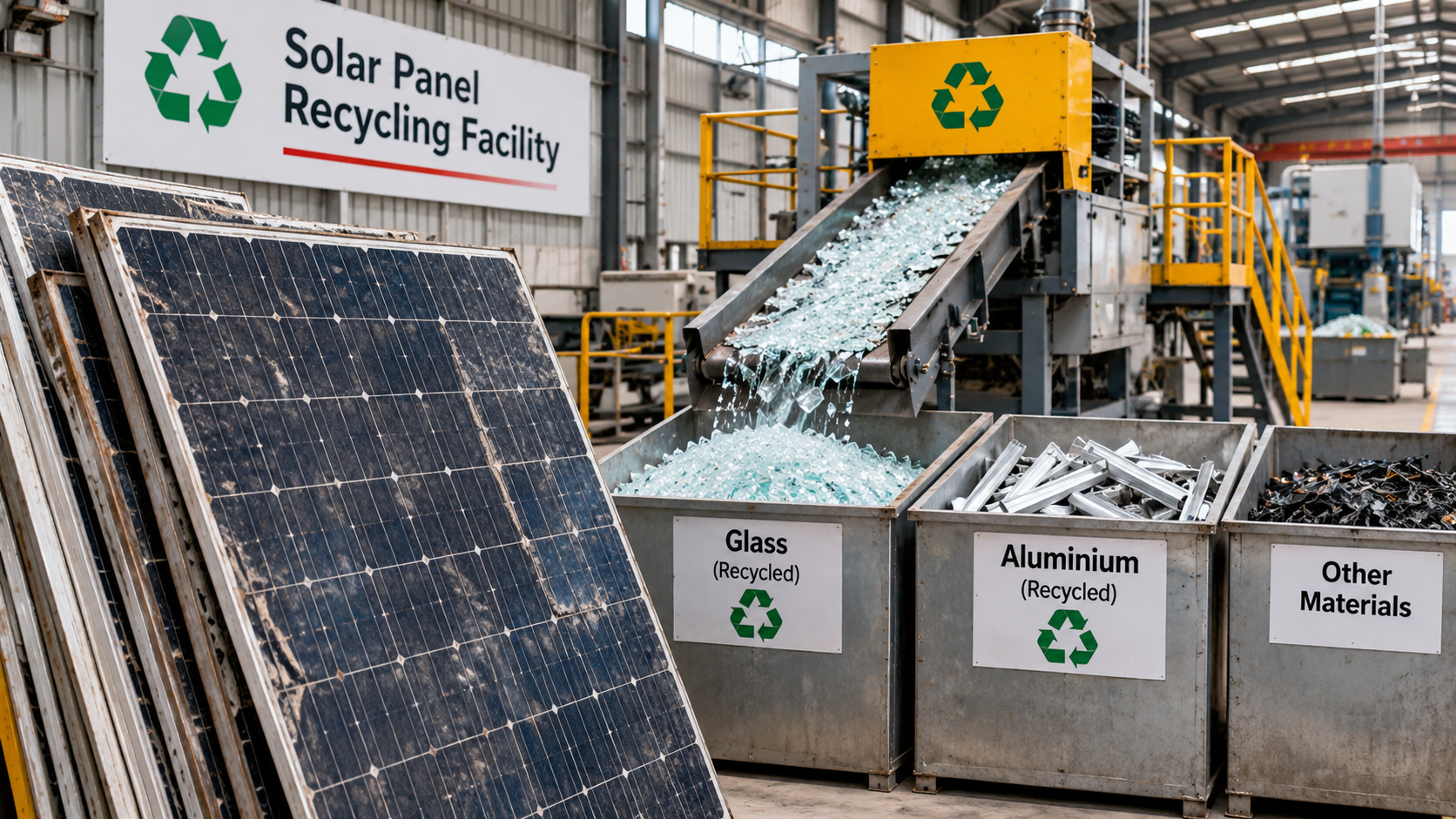

Solar Panel Recycling in India: What Solar Developers and EPC Companies Need to Prepare for Before 2035
India's solar expansion brings a new responsibility: managing damaged, rejected and end-of-life photovoltaic modules safely. Here's what developers, EPC contractors and O&M teams should understand about solar waste management.
Solar Panel Recycling in India is becoming an important consideration for solar developers, manufacturers and renewable-energy asset owners. Solar PV waste is covered under the E-Waste (Management) Rules, 2022. CPCB issued solar-specific storage and handling guidance in March 2026, while further recycling guidelines were announced as being prepared in November 2026.
India's solar industry is entering a new phase. As installed solar capacity expands, attention is turning towards a question that every project developer and asset owner will eventually need to address: what happens to solar panels when they are damaged, rejected, replaced or reach the end of their useful life?
Solar photovoltaic modules contain several materials, including glass, aluminium, silicon, polymers and metals. When modules are damaged or discarded, these materials need to be handled responsibly. Poor storage, uncontrolled breakage or inappropriate disposal can create environmental and worker-safety risks.
Why Solar Panel Recycling in India Is Becoming Important
India's first large waves of solar installations will gradually approach the end of their operating lives over the coming years. At the same time, damaged modules, manufacturing rejects and panels replaced during plant maintenance can create waste much earlier.
This makes solar waste management a practical consideration for the entire renewable-energy value chain, not simply a future recycling industry issue.
What Has Changed in India's Solar Recycling Framework in 2026?
Two developments are particularly important for the Indian solar industry.
1. CPCB issued solar waste storage and handling guidance
In March 2026, the Central Pollution Control Board published its Guidelines for Storage and Handling of Waste Solar Photo-Voltaic Modules, Panels or Cells under the E-Waste (Management) Rules, 2022.
The document provides technical guidance for the transportation, handling and storage of solar photovoltaic waste. It addresses environmental protection, safe handling, inventory records and storage conditions.
2. Government announced preparation of further recycling guidelines
On 5 November 2026, the Union Minister for New and Renewable Energy announced that the government was preparing guidelines to strengthen solar-module recycling and promote a domestic circular economy.
The announcement highlighted the need for greater recyclability in solar modules and the development of suitable recycling processes. This announcement concerns guidelines being prepared; it should not be interpreted as a newly finalised recycling regulation.
The existing E-Waste (Management) Rules, 2022 and applicable CPCB guidance remain important for current solar waste handling. Developers should verify the latest official requirements applicable to their particular role before making compliance decisions.
What Do Existing E-Waste Rules Say About Solar Panels?
Solar photovoltaic modules, panels and cells are covered under Chapter V of the E-Waste (Management) Rules, 2022. The rules establish responsibilities for manufacturers, producers and recyclers.
According to CPCB's March 2026 guidance, the solar-specific framework includes registration, storage of generated solar waste up to 2034–35, annual returns and compliance with applicable CPCB guidelines and standard operating procedures.
The CPCB guidance also clarifies that the general E-Waste recycling targets under the rules are currently not applicable to waste solar photovoltaic modules, panels or cells.
This is an important distinction. Project owners and developers should not assume that every obligation applying to other categories of electronic waste automatically applies in exactly the same way to solar modules.
What Happens to a Solar Panel During Recycling?
Solar photovoltaic module recycling generally involves separating different components and recovering materials that may be suitable for reuse or further processing.
1. Collection and identification
Damaged, rejected or discarded modules need to be identified and collected through an appropriate system. Keeping records of the module type, quantity, condition and source helps with traceability.
2. Safe transportation
Solar waste should be transported in a manner that prevents unnecessary breakage and protects workers and the surrounding environment. CPCB's guidance specifies covered trucks for transportation.
3. Disassembly and separation
The module is separated into components. Depending on the technology and recycling process, this may involve removing the aluminium frame, junction box and other components before further treatment.
4. Delamination and material recovery
The different layers of a solar module are separated using suitable processes. Recycling technologies may use mechanical methods or combinations of mechanical, thermal and chemical processes.
Potentially recoverable materials include glass, metals, polymers and solar cell materials. The actual recovery rate depends on the module design, condition and recycling technology used.
How Solar Developers Should Prepare for Solar Panel Recycling in India
Solar developers do not need to wait until the end of a plant's operating life to establish responsible waste-management practices. Early preparation can make future handling easier and improve operational documentation.
1. Maintain a solar module inventory
Keep accurate records of installed modules, including manufacturer, model, rated capacity, serial numbers where available, installation locations and replacement history.
2. Record damaged and replaced modules
Damaged panels should not disappear from the maintenance record. Document the location, date, reason for replacement, condition and quantity of modules removed from service.
Photographs and work-order references can provide useful supporting evidence for maintenance and material reconciliation.
3. Establish safe temporary storage arrangements
Damaged or discarded panels should be handled carefully. CPCB's March 2026 guidance recommends appropriate storage arrangements designed to prevent breakage and protect workers and the environment.
- Use covered storage spaces in a dry and well-ventilated area.
- Keep panels away from sharp objects and avoid collisions.
- Use an impervious, non-leachable storage floor.
- Store broken or disintegrated modules separately in suitable labelled containers.
- Maintain stable stacking arrangements and safe access.
- Provide appropriate fire protection and emergency arrangements.
- Use suitable personal protective equipment for personnel handling waste modules.
- Maintain inventory and periodic inspection records.
4. Use appropriate collection and recycling channels
CPCB's guidance states that solar waste intended for recycling should be handed over to registered e-waste recyclers. Where waste is being collected and stored, the guidance also provides for handover to registered producers and manufacturers.
Project owners should verify the relevant registration and collection arrangements before transferring discarded modules.
5. Include waste management in O&M procedures
Operations and maintenance teams should have a defined process for identifying damaged modules, recording replacements, segregating waste and coordinating its authorised collection.
This makes waste handling part of normal plant management rather than an unplanned activity whenever panels are damaged.
Solar EPC and O&M Teams: A Practical Responsibility Checklist
The following checklist can help project teams establish a more organised process for solar module waste management.
| Activity | Recommended project-level practice |
|---|---|
| Module documentation | Maintain manufacturer, model, capacity and inventory information. |
| Damage identification | Record damaged modules, location, condition and photographs. |
| Replacement records | Track modules removed and replacement modules installed. |
| Temporary storage | Follow applicable CPCB storage and handling guidance. |
| Worker safety | Provide appropriate PPE and safe handling procedures. |
| Waste transfer | Verify the authorised collection or registered recycling channel. |
| Documentation | Retain inventory, inspection, transfer and maintenance records. |
Why Solar Waste Management Matters for Karnataka's Solar Industry
Karnataka has a significant role in India's renewable-energy development. The state has utility-scale solar installations, industrial rooftop systems and supporting electrical infrastructure across different locations.
As these assets mature, plant owners and O&M teams will need reliable processes for dealing with damaged, rejected and end-of-life modules. This includes maintaining asset records, arranging safe handling, coordinating collection and understanding applicable environmental requirements.
Planning for Solar Panel Recycling in India can help Karnataka's solar developers establish better long-term asset management practices. For developers planning new installations, waste-management considerations can be incorporated into project documentation and long-term operations planning from the beginning.
What Should Solar Developers Ask Their EPC and O&M Partners?
When appointing project execution or maintenance partners, developers can ask practical questions about how damaged equipment and discarded modules will be managed.
- Does the project maintain a complete solar module inventory?
- How are damaged panels identified and documented?
- Are module replacements recorded with supporting evidence?
- Is there a defined procedure for safe temporary storage?
- How are waste collection and transfer arrangements verified?
- Are maintenance and waste records available for review?
- Are responsibilities clearly defined between the owner, EPC contractor, O&M team and producer?
How IndusAssist Supports Solar Project Development
IndusAssist Private Limited is a Bangalore-based solar and electrical infrastructure company established in 2017, with more than 250 MW of commissioned project capacity.
IndusAssist works across ground-mounted solar EPC, commercial and industrial rooftop solar, transmission line works, electrical infrastructure, EV charging solutions, machinery rental, liaisoning and technical inspection services.
Reliable solar asset management begins with sound project planning, engineering, installation, documentation and coordination. These activities help create a stronger foundation for long-term plant operations and responsible equipment management.
Explore our ground-mounted solar services, audit and third-party inspection services, and contact our team to discuss your project requirements.
Frequently Asked Questions
Are solar panels considered e-waste in India?
Yes. Solar photovoltaic modules, panels and cells are covered under Chapter V of the E-Waste (Management) Rules, 2022, subject to the specific provisions applicable to solar waste.
What are India's current rules for solar panel waste?
Solar PV waste is covered under the E-Waste (Management) Rules, 2022. The framework includes registration, storage, annual returns and compliance with applicable CPCB guidance and procedures. Specific responsibilities depend on the role of the manufacturer, producer or recycler.
What did CPCB publish about solar panel waste in 2026?
CPCB published guidelines in March 2026 covering the storage, handling and transportation of waste solar photovoltaic modules, panels and cells under the E-Waste (Management) Rules, 2022.
Can damaged solar panels be thrown away in regular landfill areas?
No. CPCB's solar waste guidance says solar waste should not be dumped in open areas or landfills. Appropriate collection, storage and authorised recycling arrangements should be followed.
How should damaged solar panels be stored?
They should be stored in a safe, covered, dry and well-ventilated space, with arrangements to prevent breakage and protect workers and the environment. Broken modules should be stored separately in suitable labelled containers.
When will India's first large solar panel waste volumes emerge?
The government has indicated that early large-scale solar installations are expected to mature around 2033–2035. However, damaged panels, manufacturing rejects and replacement modules can generate solar waste before then.
Do solar project developers need to plan for module recycling?
Developers and plant owners should plan for module identification, damage records, safe storage and appropriate collection arrangements. They should also understand which legal obligations apply to their specific role in the solar project lifecycle.
Building or Managing a Solar Power Project?
Connect with IndusAssist for ground-mounted solar EPC, rooftop solar, electrical infrastructure and project execution requirements.
Discuss Your Project →Official References and Further Reading
- CPCB – Guidelines for Storage and Handling of Waste Solar PV Modules, Panels or Cells, March 2026
- Ministry of New and Renewable Energy – Government Takes Steps to Promote Domestic Recycling Capacity and Circular Economy in Solar Sector
- The Indian Express – Government Plans Guidelines for Solar Module Waste Recycling, November 2026
- CPCB – E-Waste Management and EPR Portal