

How AI and Drones are Revolutionizing Solar Plant Inspection
AI and Drones in Solar Plant Inspection are transforming the way solar power plants are maintained. From thermal imaging and automated defect detection to predictive maintenance powered by Artificial Intelligence, these advanced technologies help Solar EPC companies improve efficiency, reduce operational costs, and maximize energy generation.
As the global adoption of solar energy continues to grow, maintaining solar power plants efficiently has become more important than ever. Whether it’s a rooftop installation or a utility-scale solar farm, regular inspections are essential to ensure optimal performance, identify faults early, and maximize energy generation.
Traditionally, solar plant inspections required technicians to manually inspect thousands of solar panels, often spending several days or even weeks completing a single project. Today, Artificial Intelligence (AI) and drone technology are transforming this process, making inspections faster, safer, more accurate, and cost-effective.
For Solar EPC companies and Operations & Maintenance (O&M) providers, AI-powered drone inspections are becoming the new industry standard.
Why Solar Plant Inspections Matter
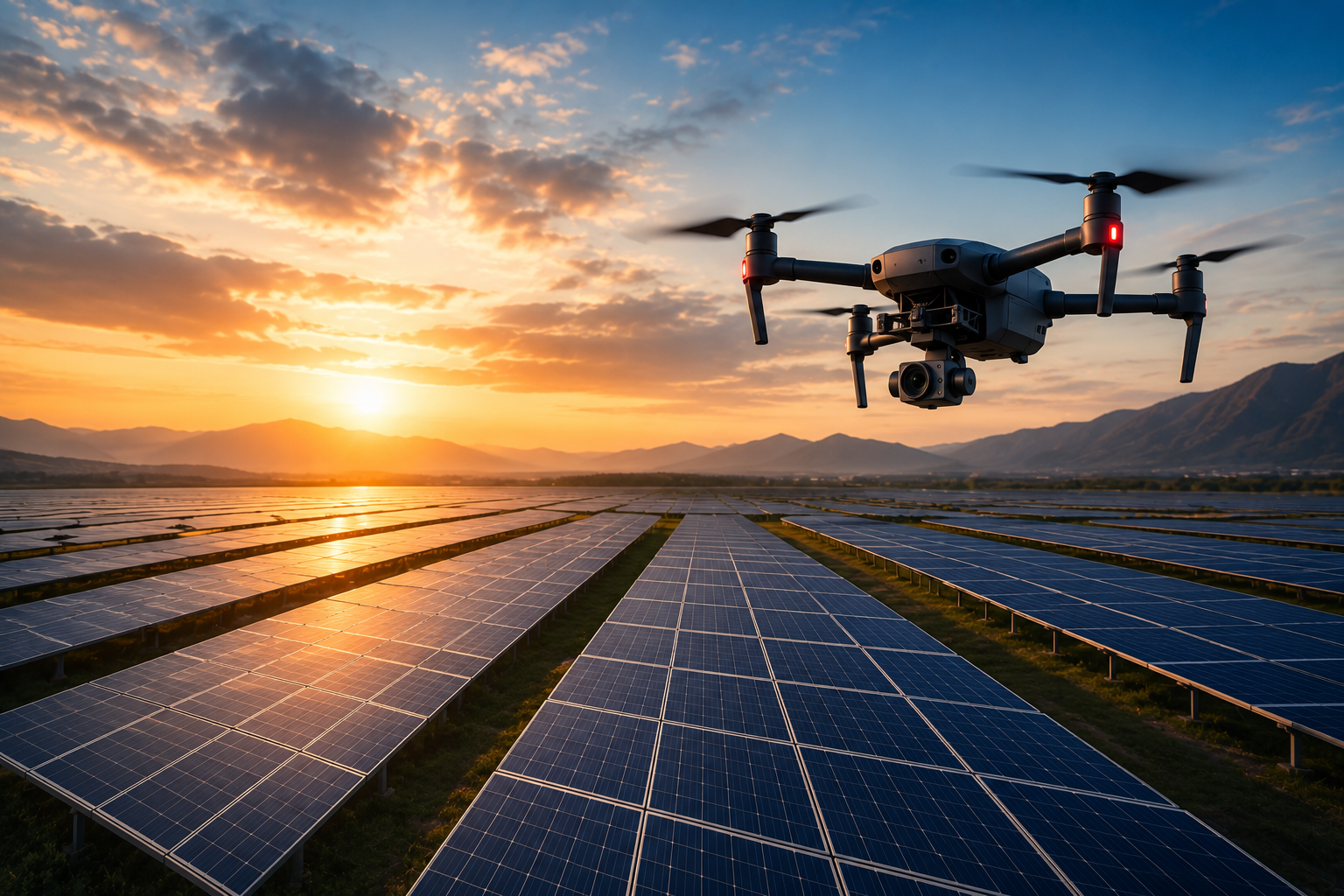
Solar plant inspection using drones
Solar panels are exposed to harsh environmental conditions throughout the year. Dust accumulation, bird droppings, loose electrical connections, damaged modules, shading, vegetation growth, and weather-related wear can significantly reduce a plant’s efficiency.
Even a single faulty solar module can affect the performance of an entire string, leading to energy losses and reduced return on investment (ROI).
Regular inspections help identify these issues before they become costly problems.
Challenges of Traditional Solar Inspections
Conventional inspection methods have several limitations:
- Manual inspection is time-consuming.
- Large solar farms require significant manpower.
- Human error can lead to missed defects.
- Accessing rooftop installations can be risky.
- Shutdowns during inspection may reduce productivity.
- Thermal hotspots are difficult to identify with the naked eye.
As solar installations continue to increase in size, these challenges become even more significant.
How Drone Technology is Changing Solar Inspections
Modern drones equipped with high-resolution RGB cameras and thermal imaging sensors can inspect thousands of solar panels within a few hours.
Instead of technicians walking through an entire solar plant, drones fly predefined routes, capturing detailed aerial images and thermal data.
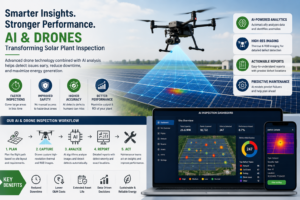
AI and Drones in Solar Plant Inspection
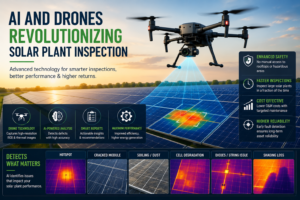
Drone inspections can identify:
- Hotspots
- Cracked solar panels
- Broken glass
- Delamination
- Cell degradation
- Loose electrical connections
- Shading issues
- Dust accumulation
- Vegetation interference
- Water ingress
This comprehensive data enables maintenance teams to focus only on affected areas, saving both time and operational costs.
The Role of Artificial Intelligence
Collecting images is only part of the process. AI adds intelligence by automatically analyzing inspection data.
Advanced AI algorithms compare thermal images, detect abnormalities, classify defects, and prioritize maintenance activities.
Instead of manually reviewing thousands of photographs, engineers receive an automated inspection report highlighting panels that require attention.
AI can identify:
- Thermal hotspots
- Underperforming modules
- String failures
- Junction box faults
- Potential diode failures
- Soiling losses
- Panel misalignment
- Structural damage
This significantly improves inspection accuracy while reducing analysis time.
Predictive Maintenance with AI
One of the biggest advantages of AI is predictive maintenance.
Rather than waiting for equipment to fail, AI analyzes historical performance data, weather conditions, and inspection reports to predict future failures.
This allows maintenance teams to replace or repair components before they affect plant performance.
Predictive maintenance helps:
- Reduce downtime
- Extend equipment lifespan
- Lower maintenance costs
- Improve plant availability
- Increase energy generation
Benefits of AI and Drone-Based Solar Inspections
Faster Inspections
Large solar farms covering hundreds of acres can be inspected in a fraction of the time required for manual inspections.
Improved Safety
Technicians no longer need to climb rooftops or walk through hazardous electrical environments.
Higher Accuracy
Thermal cameras combined with AI detect defects that are invisible during visual inspections.
Lower Operational Costs
Targeted maintenance reduces unnecessary labor and equipment expenses.
Increased Energy Output
Early detection of faults ensures solar panels continue operating at maximum efficiency.
Better Asset Management
Historical inspection data enables long-term monitoring of asset performance and degradation trends.
AI and Drones in Solar Plant Inspection
A modern solar inspection typically follows these steps:
Step 1 – Drone Flight Planning
The inspection route is programmed based on the plant layout.
Step 2 – Data Collection
The drone captures RGB and thermal images across the entire site.
Step 3 – AI Analysis
Artificial Intelligence processes the collected data and detects abnormalities.
Step 4 – Report Generation
A detailed inspection report is generated, including fault locations, thermal images, and recommended corrective actions.
Step 5 – Maintenance Execution
Engineers repair or replace defective components based on the AI-generated report.
Applications Across Solar Projects
AI-powered drone inspections are widely used for:
- Utility-scale solar farms
- Industrial rooftop solar systems
- Commercial solar installations
- Ground-mounted solar projects
- Floating solar power plants
- Solar carports
- Agricultural solar projects (Agrivoltaics)
The Future of Solar O&M
The future of solar Operations & Maintenance is becoming increasingly data-driven.
Emerging technologies include:
- AI-powered digital twins
- Autonomous inspection drones
- Robotic solar panel cleaning systems
- IoT-based performance monitoring
- Machine learning for energy forecasting
- Cloud-based asset management platforms
- Real-time predictive maintenance dashboards
Together, these innovations will make solar plants smarter, more reliable, and more efficient than ever before.
How IndusAssist Supports Smart Solar Maintenance
At IndusAssist Private Limited, we believe that solar power plants should deliver maximum performance throughout their lifecycle.
Our engineering and O&M teams focus on proactive maintenance, performance optimization, preventive inspections, and modern technologies that help improve plant efficiency and reduce operational downtime.
As AI, drone technology, and predictive analytics continue to evolve, these innovations will play a significant role in delivering smarter and more sustainable solar energy solutions for industries, commercial facilities, and utility-scale projects.
Conclusion
Artificial Intelligence and drone technology are redefining how solar plants are inspected and maintained. By combining automated aerial surveys with intelligent data analysis, businesses can detect faults earlier, reduce maintenance costs, improve safety, and maximize energy production.
As the renewable energy sector continues to expand, adopting AI-driven inspection technologies is no longer just an innovation—it is becoming an essential part of efficient solar asset management.
Frequently Asked Questions (FAQ)
Can drones inspect solar panels without shutting down the plant?
Yes. Most drone inspections can be carried out while the solar plant remains operational, minimizing disruptions.
What defects can thermal drones detect?
Thermal imaging can identify hotspots, damaged cells, loose electrical connections, string failures, shading issues, and underperforming modules.
How does AI improve solar inspections?
AI automatically analyzes thermal and visual images, detects faults, prioritizes maintenance tasks, and generates detailed inspection reports much faster than manual analysis.
Are drone inspections suitable for rooftop solar systems?
Yes. Drone inspections are highly effective for commercial, industrial, and large rooftop solar installations where manual access may be difficult or unsafe.
Why are AI-powered inspections important for solar O&M?
They improve safety, reduce maintenance costs, increase inspection accuracy, minimize downtime, and help maximize the long-term performance and reliability of solar power plants.